
In 2026, intranets and digital workplaces are still very much part of the workplace technology landscape, and digital employee experience (DEX) is just as important as ever. They support employees in their everyday work, help teams stay productive, solve tasks, ensure everyone is informed, underpin core organisational processes, help people find information and support engagement.
Organisations continue to invest in intranet and digital workplace products, hire consultants, appoint implementation partners, and deploy projects that support better DEX.
Of course, AI is increasingly appearing within the tools we use for our day-to-day work and, naturally, it is becoming more and more integrated into intranets and common digital workplace tools. While real-world deployment of AI into production is still limited, an increasing proportion of submissions feature AI in some form or another.
The 2026 Intranet and Digital Workplace Awards show the very latest trends in intranets, digital workplaces, DEX and AI. The winning entries confirm that employee experience continues to move forward and make a real difference to employees and the organisations they work for.
Full details including hundreds of screenshots can be found in the Intranet & Digital Workplace Showcase report. We’re also offering an Awards sampler, sharing the full case study from Gold winner Singapore Management University. If you haven’t purchased one of the yearly Awards reports before, be prepared to be amazed at the depth of insights and scope of screenshots shared! This will give you a sense of the value of full Showcase report.
Here’s five of the key highlights from the 2026 Intranet and Digital Workplace Awards:
1. Leading intranets act as a task-completion layer
Intranets support a range of key organisational processes, including internal communications, but at their heart intranets help employees get things done. Over the years, through an increasing number of integrations with core systems and embedded workflows, intranets have enabled users to complete tasks and simple transactions without having to leave the intranet.
Leading intranets now achieve this at scale by enabling what is effectively a “task completion layer”. This drives exceptional value, achieves strong intranet adoption, supports productivity, encourages self-service, reduces context switching, and delivers a great digital employee experience.
At global pharmaceutical company and Platinum Award winner, Boehringer Ingelheim, the excellent SharePoint intranet, INSITE, has a personalised task dashboard positioned prominently on the homepage. This helps the intranet deliver its strategic aim to design a single, personalised entry point for daily work, while meeting a wider organisational goal of creating a holistic and consistent employee experience across all digital and organisational touchpoints.
Based on the Viva Connections dashboard (now part of SharePoint), the homepage integrates with multiple systems and helps employees complete tasks, access resources, and make approvals via a series of adaptive cards. Each card links through to core systems, such as SAP (SuccessFactors, Concur, Ariba), InvoiceTrack, ServiceNow, DocuSign, Sodexo Kamasys, and Veeva via APIs. With strong execution, the dashboard achieves this at a scale that is hard to pull off, successfully moving the “line of visibility” of core applications for common individual tasks to behind a user-friendly interface on the intranet homepage.
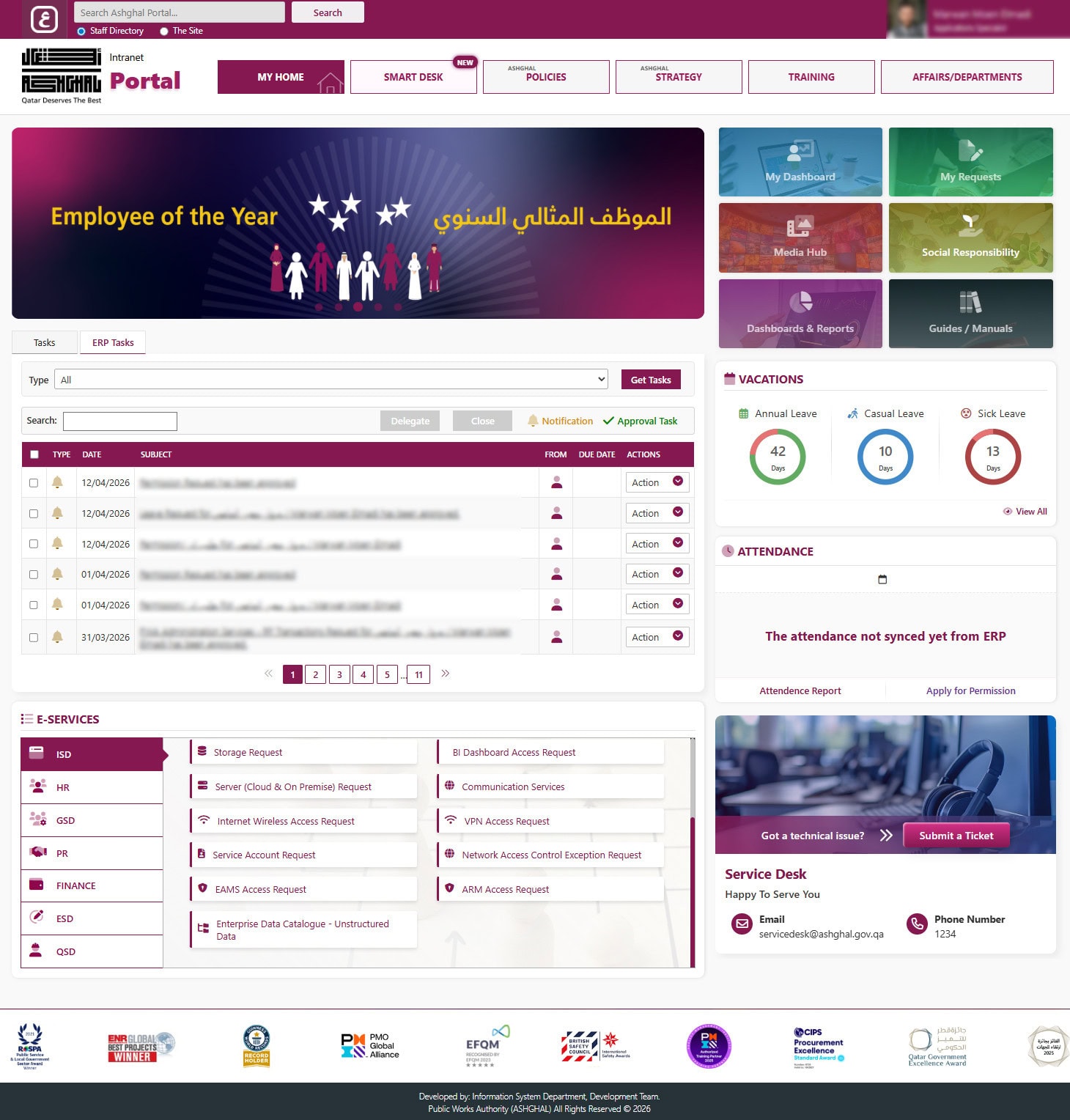
At Ashghal, a Qatari government organisation responsible for building major public infrastructure projects, the team redesigned their intranet to be a “digital command centre“, where employees can complete any task within the intranet estate. This has been achieved by presenting a highly integrated environment that brings together HR self-service, task and workflow management, dashboards, enterprise search, and an AI-powered chatbot, all into one place.
Based on a heavily-customised SharePoint environment, the intranet also presents relevant data from core systems, including Ashghal’s Oracle ERP system, and makes use of forms with workflows to digitise department-level requests. All this comes together in the homepage which is designed around three zones: one to stay informed; one to get things done (tasks and requests); and My Workspace (HR data and tasks). It’s no surprise that the intranet enjoys strong adoption and provides a strong digital foundation for getting things done.
2. Embedding AI into processes unlocks early value
AI is entering every corner of the digital workplace at speed. However, organisations are still struggling to demonstrate the value and ROI of their investment in AI, while simultaneously pushing for more adoption. Teams that take a pragmatic approach and embed AI in tangible, high-value use cases rather than a more general implementation are finding an easier and quicker route to real-world value.
Teams are also finding this pragmatic approach has additional benefits, including driving adoption, improving AI literacy and providing an effective model for further AI rollouts.
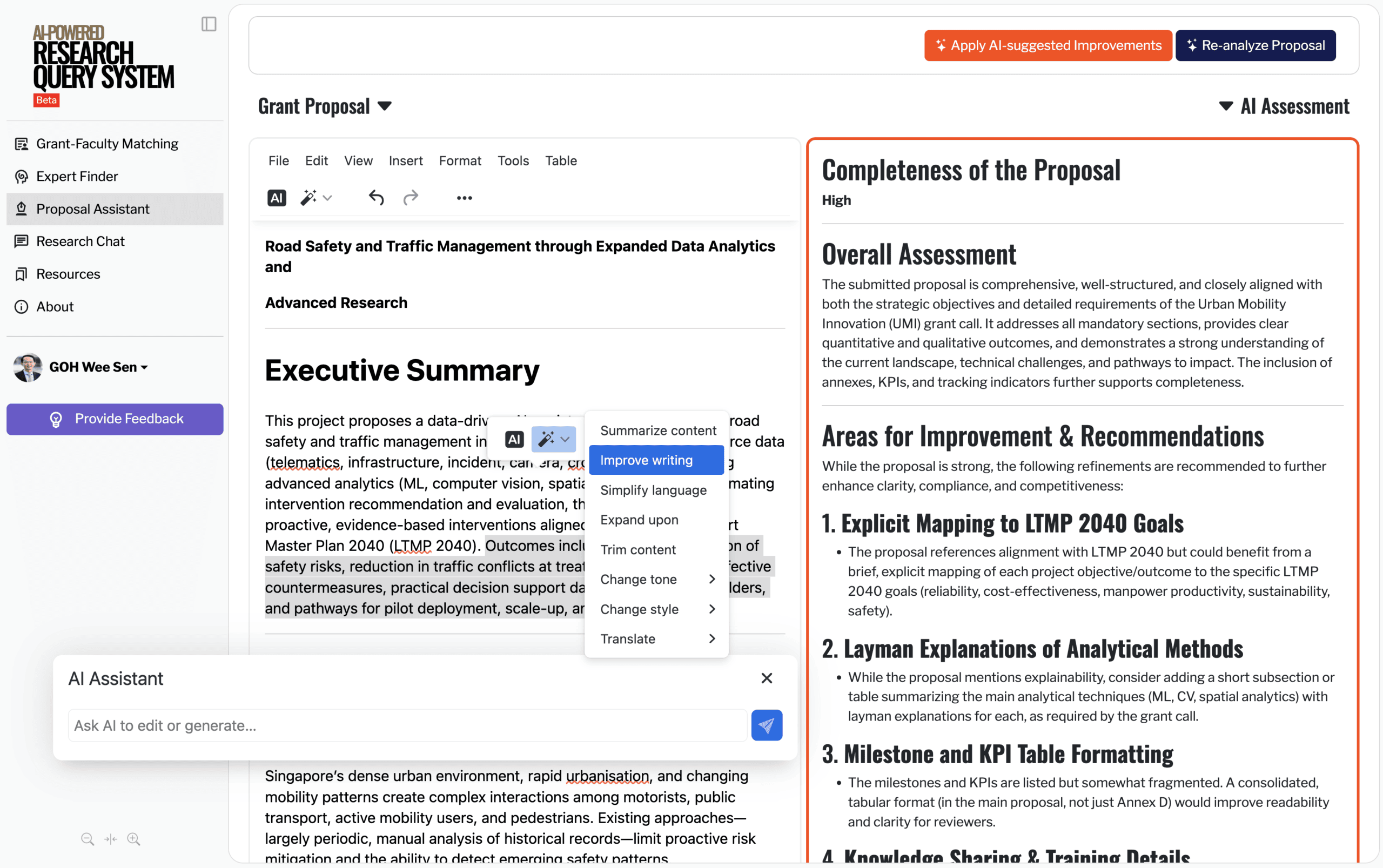
Singapore Management University (SMU) has created a set of AI-powered digital assistants that span a range of different work processes and workflows, all of which have some kind of existing friction. These AI assistants include a document screener that partly automates application reviews; a Research Query System (RQS) to aid grant applications; a lost and found assistant to help find lost property; an automatic photo cropping tool; and a corporate chatbot called Ask:Smoo.
SMU’s approach is unusual because it is a rooted in a deliberate digital strategy; they have only applied AI to existing use cases and processes where AI can make a difference, rather than through a more general launch of Copilot-style tools. This unlocks a more scalable approach to introducing AI across the university.
While this approach has supported good adoption, it has also allowed SMU to demonstrate ROI through measurable process improvement. It has also improved staff confidence in using AI, and provided a reliable and repeatable model to introduce AI across additional workflows.
At Qatari public works authority, Ashghal, the team took a similar approach, introducing Mosaed AI, an agentic AI assistant, to help employees complete specific tasks through the intranet. The capabilities focus on practical employee needs, such as HR services, IT requests, task retrieval, calendar support, ticket management, summarisation and internal search. This focuses on supporting specific tasks via AI, rather than positioning AI as a standalone or “innovation” feature.
Meanwhile, at Australian engineering and design firm Aurecon, a focused standardisation initiative, introduced by the knowledge team, consolidated technical resources across multiple disciplines using AI. With governance in place and a large collection of validated, high-value technical knowledge that supports client delivery, it was an excellent use case to introduce an AI-powered chatbot, called Agent Stan, that helps answer questions based on these resources.
Each of these use cases provides a solid example of how AI can improve a specific process or task, delivering tangible and trackable value.
3. Achieving change requires insight and creativity
Change management is a mature discipline with a number of popular frameworks, including the Prosci ADKAR model. Digital workplace, intranet and AI projects involve business change and embedding behaviours, and teams lean in to these structured models to plan out change programs.
Success is never guaranteed, particularly in areas such as enterprise social and collaboration, which require new ways of working. Digital workplace teams that successfully change behaviour and drive sustained adoption are also applying creative thinking, using techniques like storytelling, drawing on deep insights about their audience, and generally going off script to drive real change.
At the Australian bank, NAB, the team devised an imaginative and smart campaign to drive the adoption of Viva Engage. Using a set of principles that included humour and storytelling, the team took an unusual leader-led approach to change. This focused efforts on changing the behaviour of senior leaders, rather than relying on the more traditional route of using digital workplace champions across the workforce. This resulted in a more sustained impact on adoption across the enterprise.
The team delivered a highly creative campaign that they knew what would make its audience tick. This included targeted printed assets for leaders, a sleek design concept based around travel, a set of humorous videos starring real employees, and a “Willy Wonka”-style golden ticket activation across global offices. The result has seen strong adoption and leader participation in Engage, compared to the legacy solution.
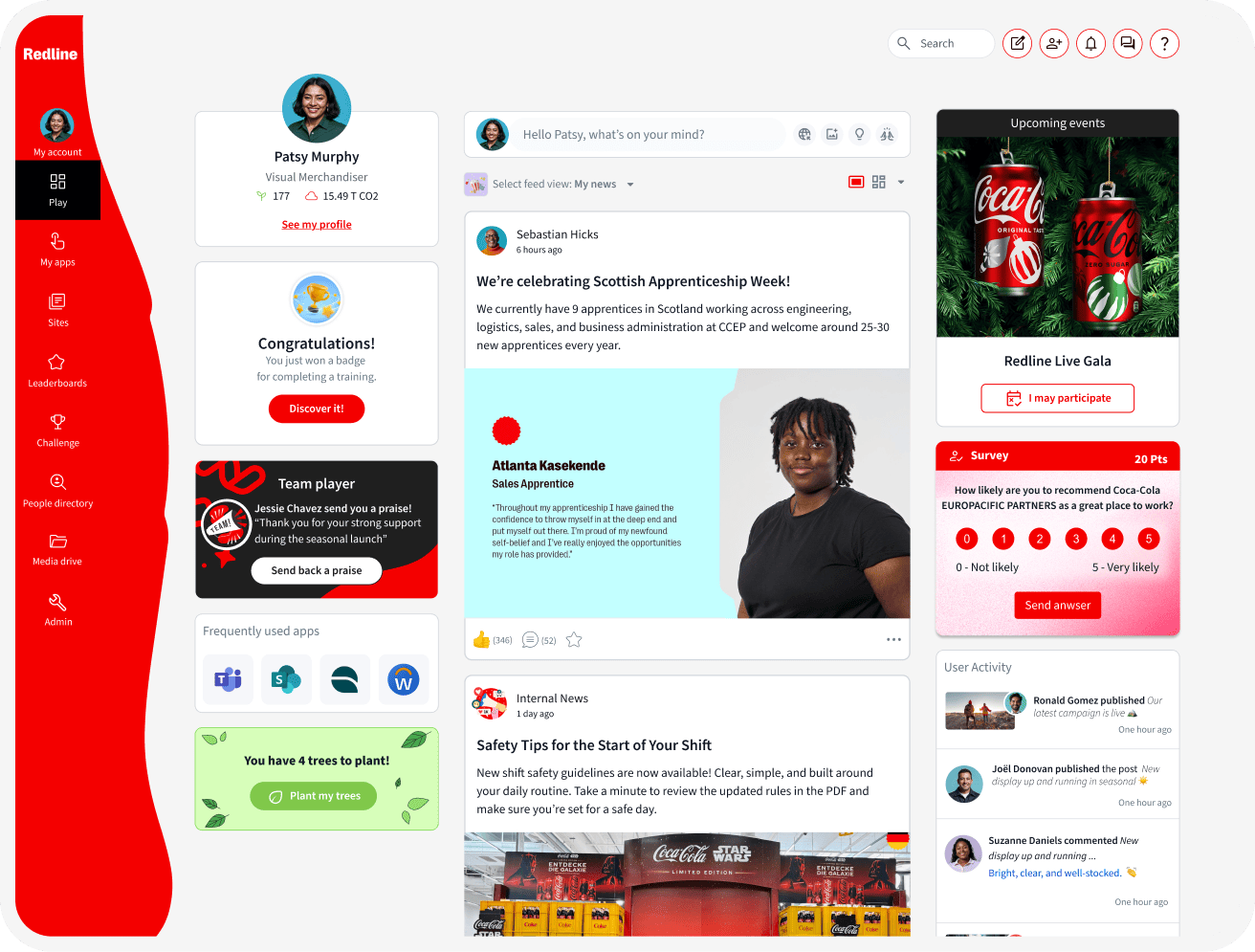
Reducing resistance to change At Cola-Cola Europacific Partners, the project team needed to extend an existing social intranet, based on the Sociabble platform, to Asia-Pacific locations. It was replacing Workplace, which had previously proved very popular, so the transition to the new solution was not expected to be bump-free.
With an aim to drive smooth change, the team took time to carry out a research-and-discovery exercise, to design a change program based on insights, as well as establish an alignment phase to secure a consensus on a decision to move to the united intranet. Based on their learnings, the team, somewhat counter-intuitively, decided to launch in Australia, where there was likely to be the most resistance. They also adopted smart and targeted launch tactics for each market in what proved to be a highly successful rollout.
4. Next generation personalisation drives DEX
The use of personas is mature within digital workplace circles. Defined and evolved through user research, personas help teams to design and define targeted experiences and content strategies, which are then supported by personalisation models and related analytics.
Savvy teams wanting to drive next-generation personalisation across intranets and digital workplaces are developing and evolving personas, and underlying persona models, to establish more effective and dynamic digital employee experiences.
Alliander, a government organisation that runs energy networks in the Netherlands, has a high-performing intranet, with very high adoption, based on years of continuous improvement. For over a decade, the intranet team have used personas to ensure experiences are targeted to different groups, including frontline staff.
In order to develop a brand new, personalised intranet hub, the team undertook extensive research to model five new digital employee experience (DEX) personas; from field service and technical professionals to support staff, office workers and leadership. With an eye on the AI-enabled future, the associated discovery exercise also covered digital and AI skills.
These personas relate to a four-layer experience model that help define the view on the homepage for different user groups, supporting DEX. Continuous improvement is also considered, with the team setting up analytics that track user behaviour across each of the personas.Â
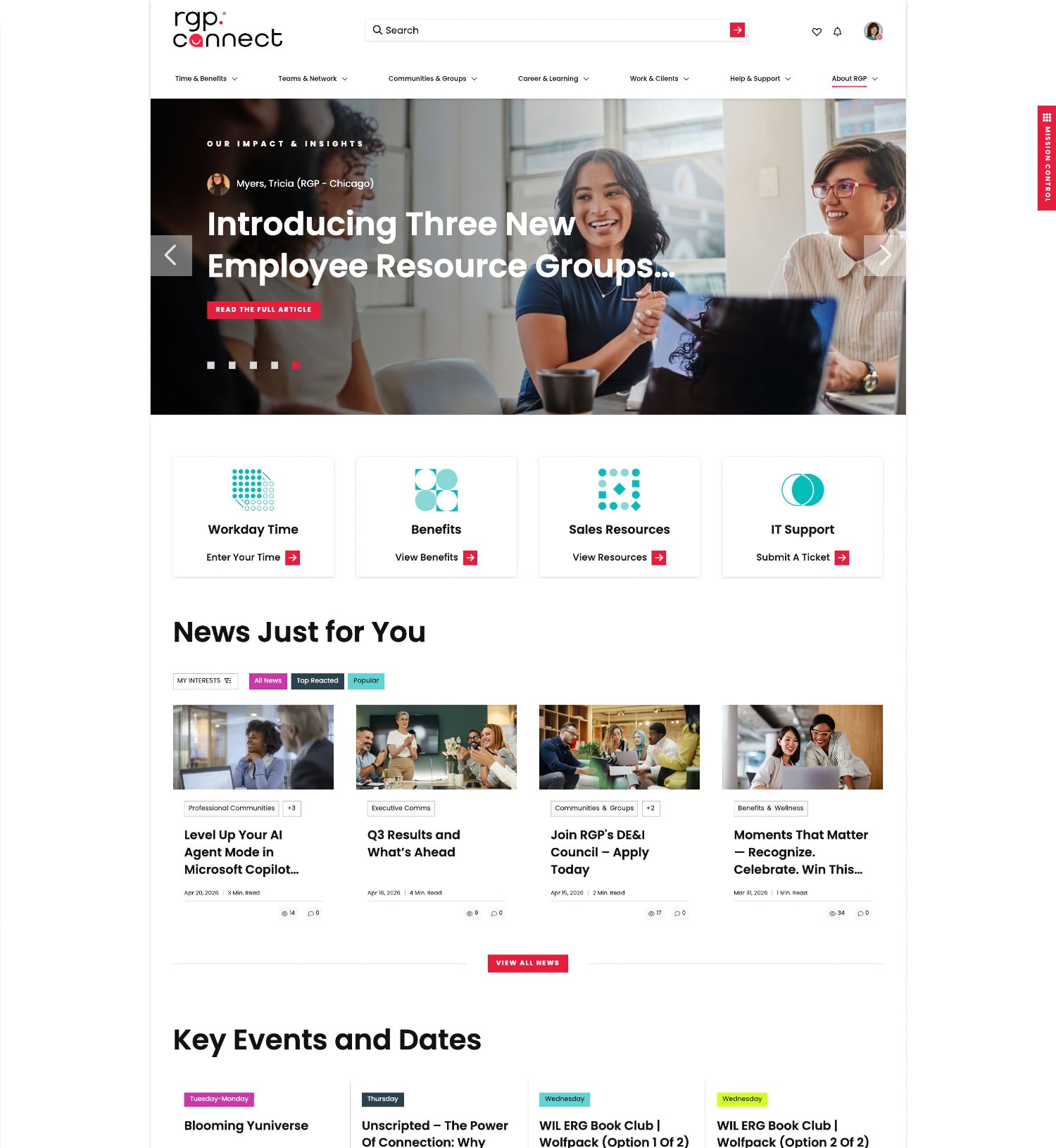
Global consultancy firm, RGP, wanted to create an intranet wrapped around the work of key groups, including its busy consultants, who mainly work offsite. They succeed by establishing integrations into core systems that expose data from HR, project, sales, and other key platforms in innovative ways. These help consultants navigate the full project lifecycle.
At the heart of “RGP Connect” is a persona-driven content model, powered by data from multiple systems, which tailors what each employee sees based on their employee ID, employee type, role, location, seniority level, and memberships. This persona-driven experience extends across communications, resources, search results, and transactional experiences such as support requests.
Like at Alliander, the solid thinking behind the persona model, combined with its successful execution through the intranet, is supporting excellent DEX.
5. Frontline engagement starts with the frontline
Organisations struggle to engage frontline employees. Many working on the frontline feel less connected to their employer compared to those based in offices. Despite dedicated digital channels, apps and tools, successful communication to these groups remains a challenge. Savvy organisations that heavily involve frontline staff in the process to design and evolve digital channels and tools for the frontline are getting better results.
Getting frontline staff to input into the scope, design, and content for an intranet or an app ensures better alignment with specific frontline needs, as well as supporting advocacy to drive adoption.
At Smulders Projects Poland, a small specialist manufacturer based across three sites, digital communication was a key challenge. What started as a project to improve onboarding ended up being a wider brief to develop a mobile-first engagement and communication app called “SPP Halo”.
Frontline staff were heavily involved from the outset, firstly in a series of “Tone of Voice” workshops, to define an approach to communications, then in providing ongoing input and feedback during the project, and finally acting as ambassadors for the launch.
This early involvement paid dividends, not only in ensuring that the app is firmly anchored around frontline needs, but also has good levels of adoption that are likely to grow as the number of features continues to expand. SPP Halo also has a sky-high eNPS score, showing that it resonates with production staff working in the plants.
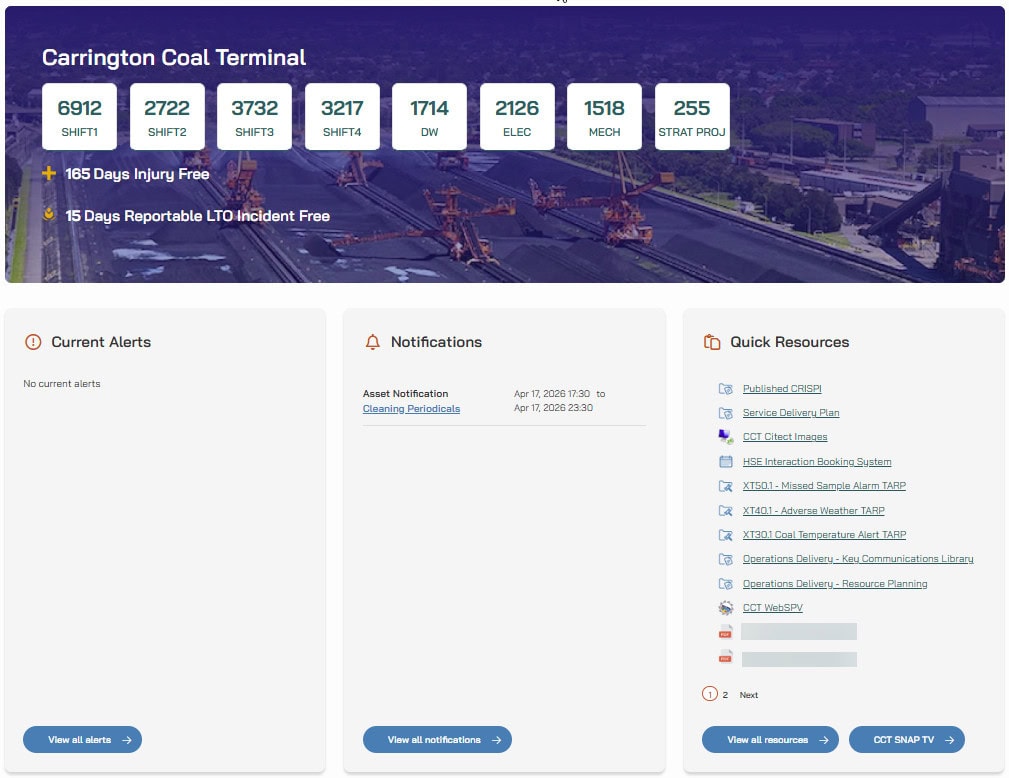
Australian company, Port Waratah Coal Services, supports the coal supply chain across two sites, with a predominantly frontline workforce. The company invested in a brand new intranet in order to better serve the needs of this demographic. Like Smulders, it chose to involve frontline employees from the get-go, through a set of workshops that took into account the pain points of frontline operations staff.
As a result, the new intranet is focused on the needs of the majority of staff, achieving 100% reach for the first time ever. It improved mobile access, made it easier for frontline staff to contribute, and provided easier access to important health and safety information. In addition, feedback from frontline staff has resulted in important business-wide safety and environmental KPIs being displayed prominently at the top of every page, while two dedicated pages show deeper data for each terminal. The combination of these features has seen a welcome increase in adoption, with at least half of all users each day coming from frontline operations.
6. Intranet teams keep pushing to deliver success
Intranets are still commonly run by small central teams, despite having to serve the needs of thousands of employees. Intranet projects are also tightly constrained in their resources, but intranet teams continually punch above their weight, overcoming challenges to deliver exceptional value across large workforces.
The secret to their success? It is down to the team themselves, demonstrating a combination of strong execution, robust governance, pragmatic thinking, sheer persistence, great resilience, and a can-do mindset. Intranet functions truly embody the spirit of the “small but mighty” team.
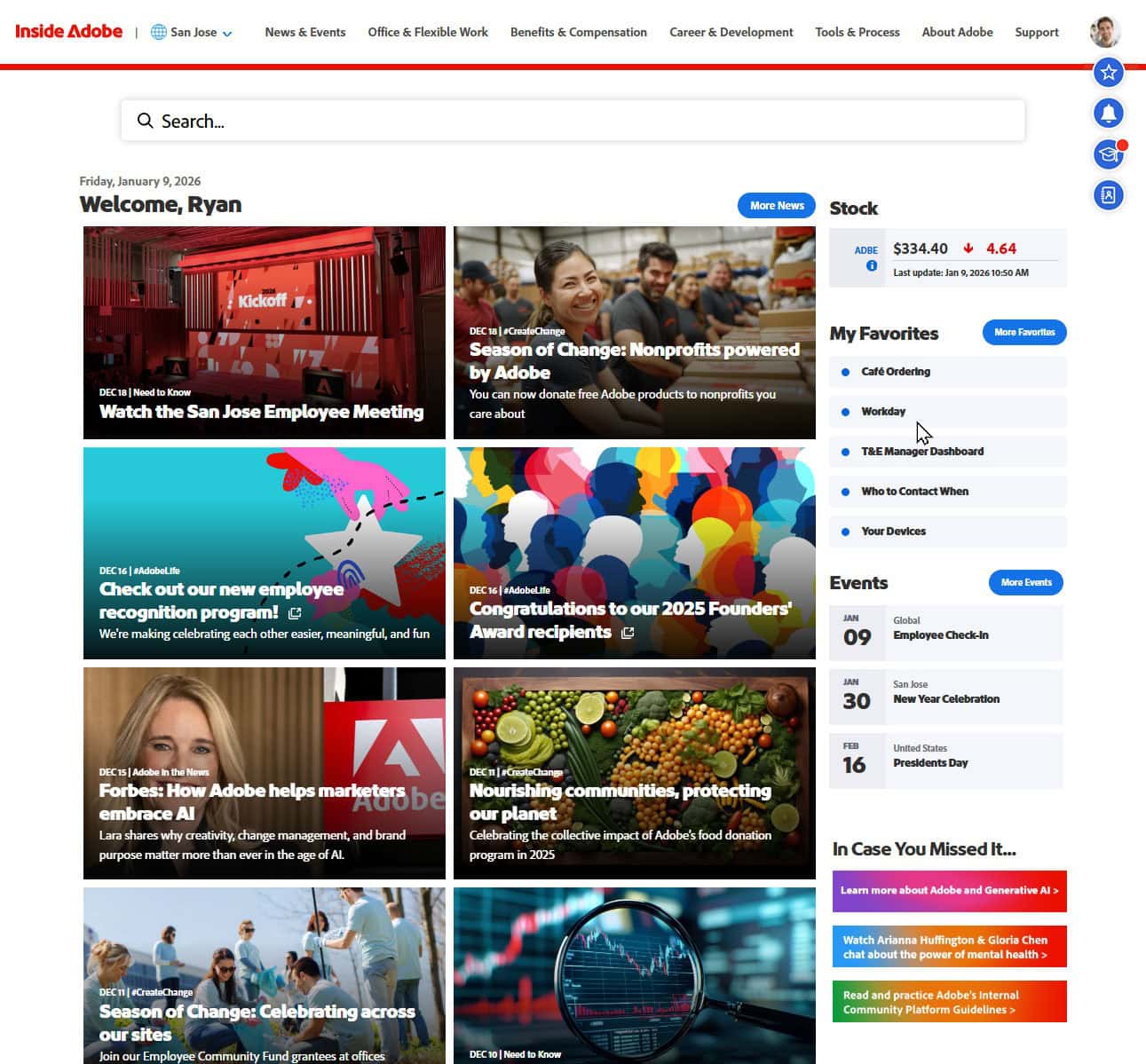
At Adobe, a compact team of five manage “Inside Adobe”, an intranet that has been continuously improved over twenty years and has gone through multiple iterations. The team have been able to drive strong adoption and deliver value through very well-implemented governance that underpins relevant content, as well as a strong commitment to using analytics and employee feedback to guide improvements.
The team have a strong service ethic, reflected in SLAs that promise to respond to employee feedback within 24 hours. Integrations with Slack also help the team and content owners to keep on top of intranet and content management tasks.
Unusually, the intranet also acts as “Customer Zero”, where new Adobe product features are tested before being publicly released. This means the team drive additional value by contributing to product development, as well as driving sales by frequently taking part in demonstrations of Inside Adobe to other intranet teams.
DTEK, a Ukrainian energy company with a predominantly frontline workforce, delivered a large, complex intranet in incredibly difficult circumstances. Against the backdrop of the war in Ukraine, with major disruption, energy blackouts, extreme temperatures, and a highly stressful situation, the intranet project team (including both employees and an external partner) showed exceptional resilience and persistence to deliver a complex group intranet project to 55,000 employees.
The intranet team continually took a pragmatic approach to getting the project over the line, relying on clear communication, a strong will and a can-do attitude. They were even able to carefully manoeuvre around a rebrand, announced shortly before go-live, having built in some flexibility to the delivered solution. This inspiring example illustrates how teams of intranet professionals will always be the essential “ingredient” that drives intranet success.
Get inspiration from 12 great case studies with screenshots
The full 2026 Intranet and Digital Workplaces Showcase report features detailed case studies of all 12 winning entries, each detailed with multiple screen shots of the sites in question. At AU$299 it’s exceptional value, helping to both inform and inspire intranet and digital workplace teams. Report sales also support the effort it takes us to keep on running the Awards (which have no associated fees).
If you want to get a sense of what a case study looks like, you can also download the Awards sampler, sharing the full case study from Singapore Management University.
Enter next year!
If you’re currently doing great work on your intranet or digital workplace, visit the Awards page, and sign up to be notified when next year’s Awards opens for entries in February 2027.