

 BEST PRACTICE ARTICLE



Filed under: Digital workplace, Intranets, Microsoft 365
The initial deployment of SharePoint Online starts small, with a handful of sites, one of which may feature the unimaginative “Hello world!”. As the value of SharePoint becomes apparent, many more sites are rapidly created, leading to a sprawling landscape of hundreds or (even thousands) of sites.
By default, this SharePoint Online landscape is useful but messy. Sites have been created by many business areas, with different audiences, intents, management practices, and quality standards. As a result, users, search and AI all struggle.
What’s needed is meaningful business-oriented governance. There’s no single right approach to this, however, as governance for a local council will be very different from a bank or a multinational.
This is where Step Two’s Universal Model for SharePoint provides invaluable guidance, allowing governance to be matched to the desired topology of the SharePoint landscape.
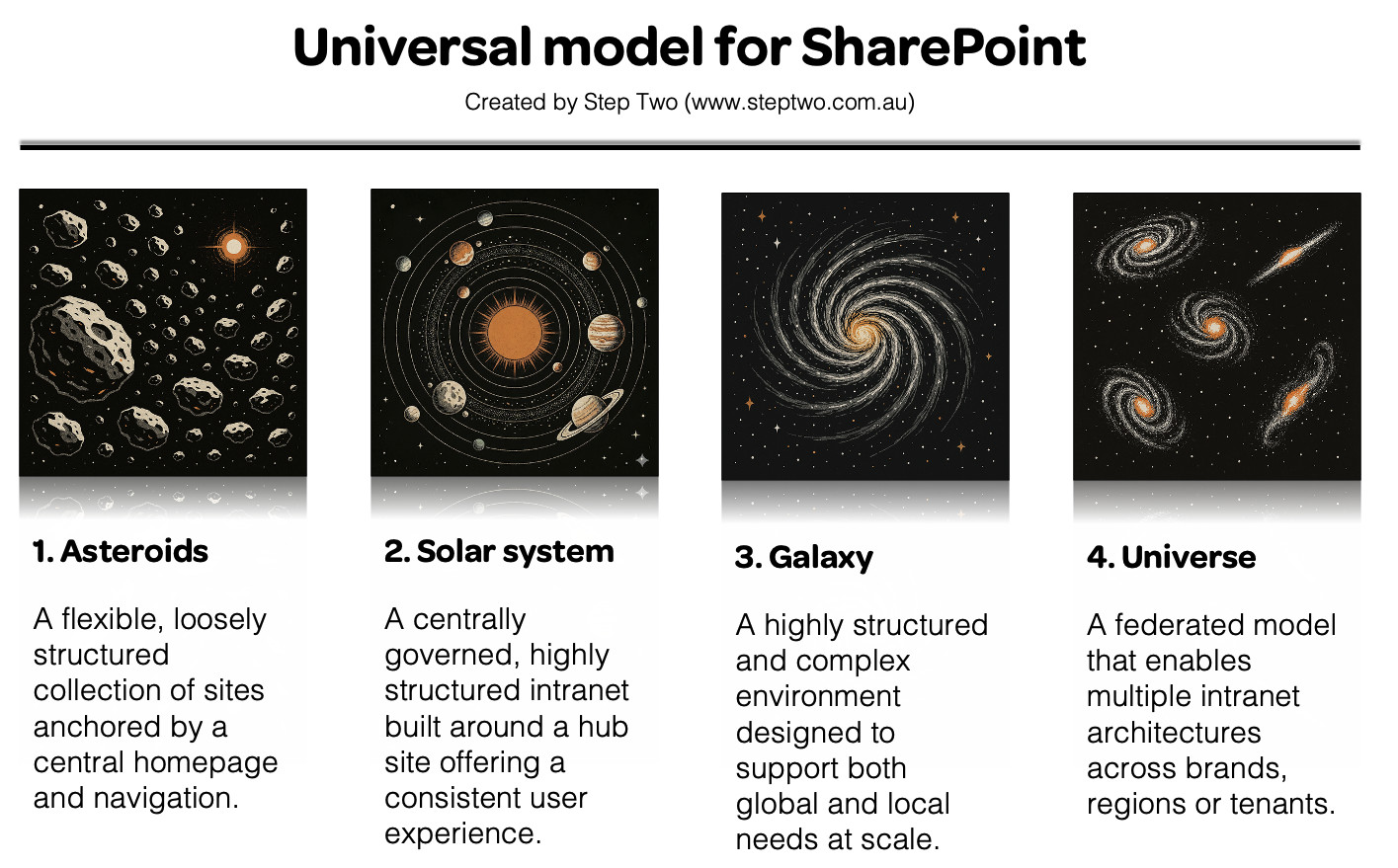
Universal Model for SharePoint
The Universal Model has emerged from Step Two’s consulting practice (and our Step Two Forum), which has enabled us to see into hundreds of different organisations. We’ve seen practices that work, and many more examples where SharePoint has “gotten loose”, leading to overwhelming sprawl.
Thankfully the Universal Model can be used to shape appropriate governance practices:
- Asteroids: Light‑touch and relationship‑based. Support focuses on enablement, with the central team leading by example and relying on self‑service guidance and goodwill.
- Solar system: Centralised and clearly defined. The central team provides structured support, training and decision‑making, with business areas operating within established rules.
- Galaxy: Broad and inclusive. The central team works in partnership with functional leads and regional stakeholders, supported by round table governance to ensure alignment across the ecosystem.
- Universe: Highly varied across entities. Central teams may offer guidance or technical oversight and support but authority typically rests with local business units, brands, or regions.
Download the free whitepaper to explore the Universal Model further.
Now let’s dig into governance approaches for each topology:
Governance for Asteroids
In this topology, the intranet team provides advisory support but lacks the resources or authority to enforce compliance or standardisation. There is no central strategic mandate, and site provisioning is ad hoc or loosely guided, with no formal approval process. Site owners have full autonomy over structure and content, enabling flexibility but also requiring self-management.
Governance is typically applied retroactively, responding to emerging needs or risks rather than being embedded from the outset. Despite this, the model supports targeted, continuous improvement through coaching, templates, and shared best practices.
The central team should:
- plan for evolution
- provide training and guidance
- establish a content community of practice
- govern in a collaborative way
- use the home site as a compass
Governance for the Solar System
In this topology, governance is centralised, strategic, and robust. The central team holds both operational and strategic control, supported by strong cross-functional governance and executive backing. Site ownership is centralised, with clearly defined roles for content authorship.
Governance is embedded from the outset, ensuring consistent user experience, branding, and structure across all sites. Templates, standards, and processes are enforced to maintain cohesion and trust.
The central team should:
- plan for sustainability
- create templates
- define consistent standards and processes
- conduct routine audits and peer reviews
- offer structured onboarding for content owners
Governance for the Galaxy
In this topology, governance is shared and federated, balancing central oversight with local autonomy. A central team works in partnership with functional leads and regional stakeholders, to ensure alignment across the ecosystem.
While core governance standards—such as UX, branding, and templated provisioning—are centrally defined and enforced, other governance processes may vary by hub to reflect local needs.
The central team should:
- establish shared governance
- define flexible standards
- implement centralised provisioning and consistent templates
- integrate new business units and acquisitions thoughtfully
- monitor practices and constantly evolve governance
Governance for the Universe
In this topology, governance is decentralised and varies widely across entities. Some areas follow structured, formal governance, while others operate with minimal oversight. Central teams may offer guidance or shared tools, but authority typically rests with local business units, brands, or regions.
Rather than enforcing uniformity, governance in this topology supports autonomy, coexistence, and alignment where it adds value.
The central team should:
- map the whole ecosystem
- establish security foundations
- establish a federated governance model
- facilitate knowledge sharing
- plan for complexity, and accept variations
Putting this into practice
When it comes to establishing and sustaining appropriate governance practices, the Universal Model gains further superpowers when paired with Step Two’s unique Intranet Operating Model:
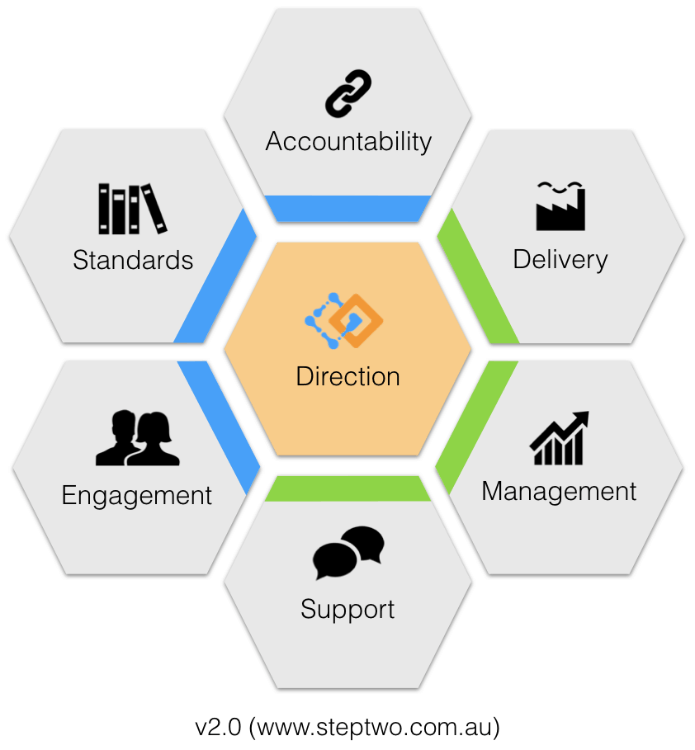
The Intranet Operating Model provides a “home” for the many governance decisions and practices that come out of the desired topology in the Universal Model. This allows a scalable approach that can be extended as governance practices evolve and mature.
For example, the “guiding” half of the model (marked in blue) provides a home for:
- Standards: may be loose or flexible (Asteroids and Universe), or documented and consistent (Solar System and Galaxy).
- Accountability: ranges from centralised (Solar System and Galaxy) to more decentralised (Universe).
- Engagement: more open and collaborative (Galaxy and Universe) or more structured and top-down (Solar System).
For the “doing” half of the model (marked in green):
- Support: high touch and hands-on (Solar System) through to looser knowledge sharing (Universe).
- Management: highly consistent and templated (Solar System) or more advisory (Asteroids and Universe).
- Delivery: ranges from adding structure after the fact (Asteroids) to more disciplined provisioning (Solar System and Galaxy).
Combining these two best-practice frameworks allows real-world governance to be established in every SharePoint Online landscape, no matter how large or complex. It also gives central teams confidence that the governance approach is a good match for their current (and desired) circumstances.
Reach out if you’d like help from our team is establishing effective SharePoint Online governance in your tenant(s).