

 BEST PRACTICE ARTICLE



Filed under: Microsoft 365, SharePoint
SharePoint Online is by far the dominant platform for intranets and other digital workplace solutions. A big part of its success rests on its inherent fluidity, enabling it to grow and flex to meet many different business objectives. Its value as a platform is also further increasing, as a foundation for new AI capabilities.
SharePoint, however, has no inherent ‘shape’ or structure.
Microsoft gives no clear guidance or support on how to shape the SharePoint landscape beyond technical considerations. With each new feature that’s been added, the functionality of SharePoint has increased, but often at the cost of further complexity.
In our consulting work, we’ve seen the dark side of this flexibility.
Without careful management (and a clear strategy!), SharePoint invariably leads to sprawl. Having 250+ SharePoint sites is virtually universal, and we’ve seen larger organisations with 75,000+. And that’s separating out ‘publishing’ sites from the sites that are created as content stores for MS Teams (etc).
The sprawl and lack of structure generates many problems:
- poor digital employee experience
- no clear structure for intranets and other digital workplace solutions
- ineffective search
- absence of effective governance
- content management and content quality issues
- misalignment between stakeholders
- wasted effort and resources
- IT management and security issues
To address these challenges, and to provide a clear way forward for organisations of any size, Step Two has created the Universal model for SharePoint (free whitepaper download).
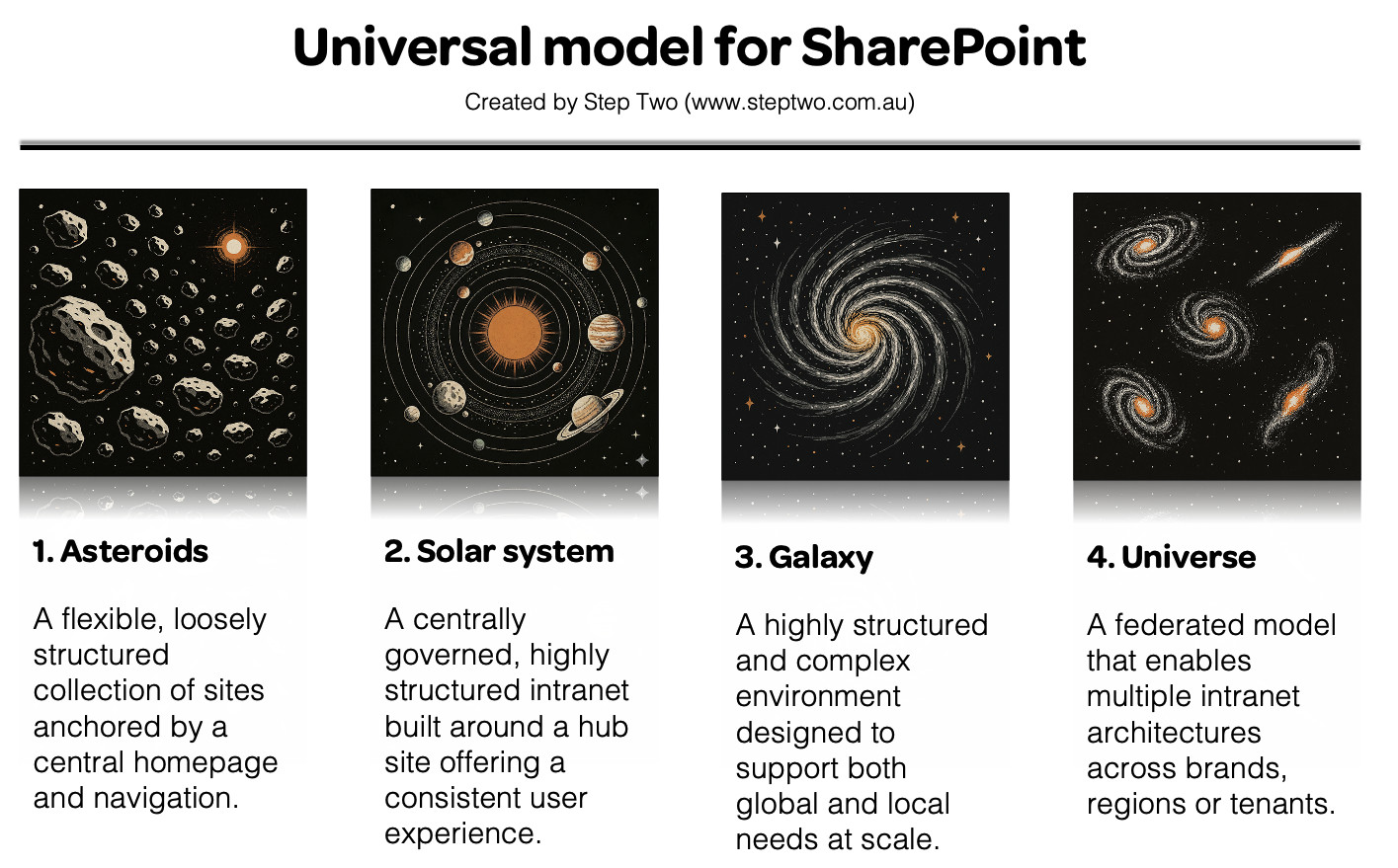
Introducing the Universal model for SharePoint
Drawing on our work with clients (particularly larger and more complex firms), we’ve developed a model for SharePoint that’s constructed around four different ‘topologies‘. Each topology describes approaches that we’ve seen work well in the wild, and they range from the small and simple to huge and all-encompassing.
The four topologies are:
- Asteroids: A loosely connected set of SharePoint sites, accessed via a single homepage. Most commonly seen in early-stage intranets, or where there is ‘light touch’ governance.
- Solar System: A single set of highly structured SharePoint sites connected to a central hub site with a consistent user experience. The most common shape for corporate intranets.
- Galaxy: A sophisticated SharePoint environment designed to meet both global and local needs at scale. Consists of a layered collection of hubs and sites with a central home site.
- Universe: A multifaceted SharePoint environment composed of multiple coexisting architectures — satellites, solar systems, galaxies — each shaped by the needs of its local entity.
The Universal model for SharePoint can be used to:
- map and understand your current landscape
- identify your target topology or lock in your current one
- align stakeholders around a common understanding
- establish a suitable SharePoint architecture
- design an employee experience that works
- shape effective governance practices
Download the full whitepaper
 The Universal model for SharePoint whitepaper is a free download that explores the four topologies, describing for each: SharePoint architecture, advantages, disadvantages and recommendations.
Use the whitepaper to understand the model, and then to put it into practice.
Obtain expert assistance
The Universal model for SharePoint combines Step Two’s three decades of intranet best practice knowledge with the practical realities that we see today in all of our clients. The model has been created to help organisations (and teams!) thrive in even the most complex of situations.
We encourage you to call on our consulting services to help put the Universal model into practice, including:
- reviewing your current SharePoint landscape
- identifying the most appropriate topology
- developing a roadmap that moves you from the current to ideal state
- aligning stakeholders around key decisions and directions
- shaping an appropriate SharePoint architecture for your intranet
- establishing effective SharePoint governance
- establishing foundations to support AI objectives
Get in touch to learn more about how we can help.