
 BEST PRACTICE ARTICLE



Filed under: Digital employee experience
Chief Human Resource Officers (CHROs) are often seen as the ‘heart’ of an organisation, with their focus on the human needs of all employees. They are also responsible for providing some of the most commonly used corporate services, such as applying for leave or managing pay.
More than this, CHROs are increasingly playing a more proactive role, with the goal of improving employee engagement and conducting ‘digital HR’ transformation.
All of these activities and considerations can be considered part of an overarching digital employee experience (DEX). More than just participants in DEX projects, CHROs can play a key leadership role at a strategic level.
While there are many opportunities to deliver improvements to employee experience, CHROs commonly target three aspects: onboarding, the delivery of HR services, and improving employee engagement.
Supporting onboarding
The first few days, weeks and even months in an organisation present a steep learning curve for new employees. Without a network of internal relationships, new starters can feel isolated and overwhelmed.
A 2017 survey of 4,000 office workers conducted by cloud software company webonboarding found that more than a third of respondents had a poor onboarding experience, with one in seven leaving their new employee within a few days due to these issues. Most concerning was the 22% who said there had been such serious issues that they had changed their mind about the job before their official start date.
This shows the need to provide a positive digital employee experience for new starters, and the CHRO’s opportunity to make a measurable impact on hiring and retention rates.
Leading firms are increasingly providing new hires with access to some (or all) of the intranet before their official start date, playing into a mutual desire to be productive from day one onwards. This can be supplemented by tailor-made content for new starters, including introductory videos, interactive training modules, and scheduled communications.
Once the new hire has started, an effective digital employee experience would involve proactively connecting employees into appropriate collaboration spaces, giving them an interactive checklist of tasks to work through, and providing them with a clear understanding of the organisational structure and business practices.
To get the greatest improvements, follow a holistic methodology for improving onboarding DEX that is structured around meaningful employee research, and solution delivery by a multidisciplinary team.
Onboarding as part of a new digital workplace
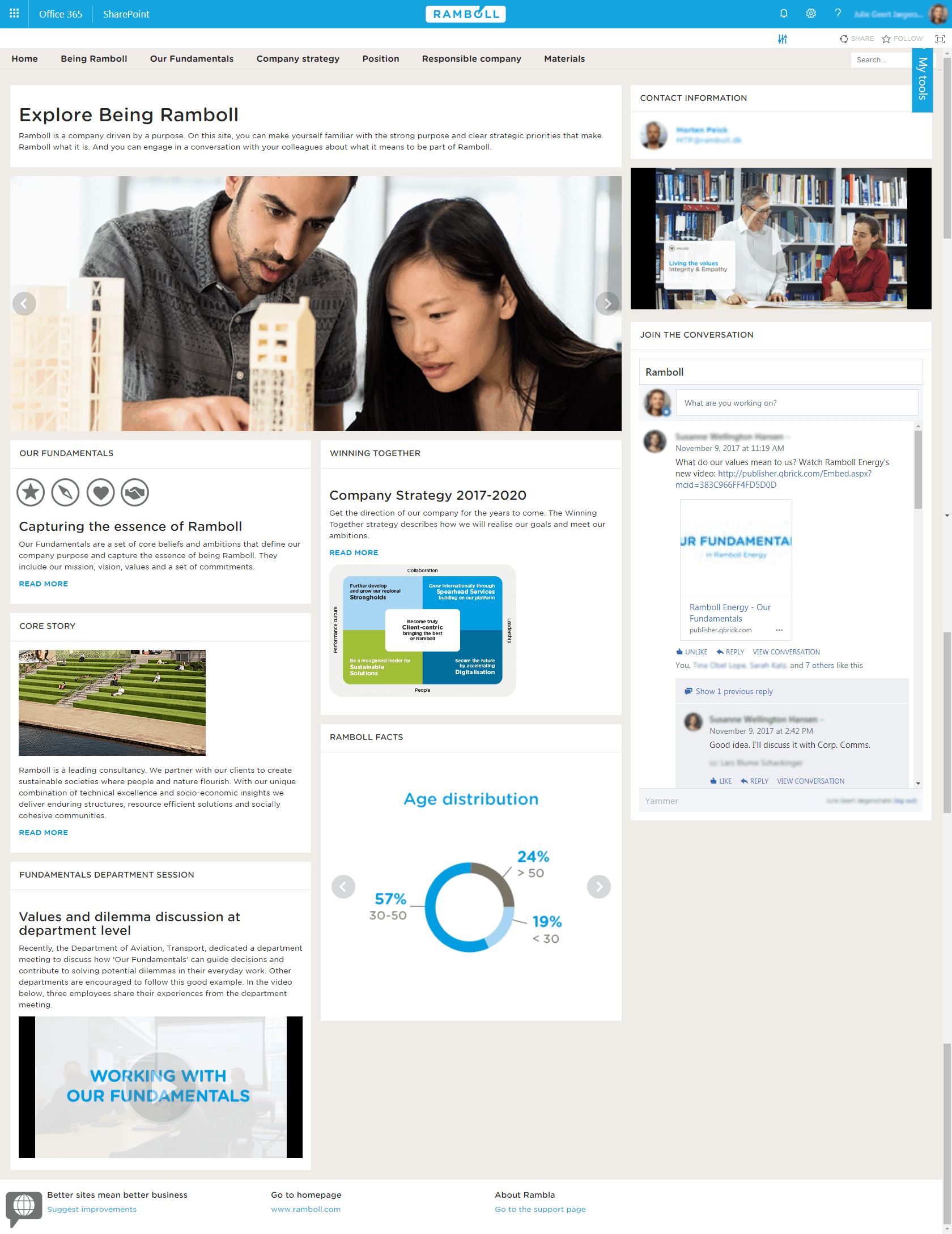
The culture section of Rambla, Ramboll’s global intranet. Screenshot courtesy of Ramboll.
In the global Intranet & Digital Workplace Awards, the Danish-headquartered engineering firm Ramboll Group won an Award for their new global digital workplace, hosted on Office 365.
Despite the tight timeframes, the project team took a best-practice approach to launching ‘Rambla’, their new corporate intranet.
From the outset, Ramboll’s CEO Jens-Peter Saul set a clear goal: “With our Winning Together strategy we want to take advantage of digitalisation to develop our services and support our clients in new and better ways. A digital workspace will help with this as it gives all employees access to the same updated Ramboll insights. It will also facilitate breaking down of organisational silos and strengthen collaboration across countries, offices, and markets”.
With this objective in mind, the project took a phased approach to delivering new capabilities, including richer collaboration and improved search.
The first element to be delivered was ‘Being Ramboll’, Ramboll’s intranet-based culture and strategy site, where new employees are invited to learn more about the company before their first day at Ramboll. The site is also used by established employees to look up details of the company strategy, values and culture.
This provided a ‘sneak peek’ of what to expect from the future digital environment and also a way to test the system, templates and design. Following this were further solutions, including a Project Portal and Sales Funnel.
Simplifying HR interactions
Human resources is often the single largest provider of corporate services to employees, from initial induction and training, through to career development and at the end of things, offboarding.
In many cases, these HR services are delivered via a collection of different systems, each obtained at different times and working in a disjointed way with other systems (if at all).This can include standalone payroll, personnel and e-learning products.
Most of these legacy systems provide a poor experience on mobile devices, and may involve multiple logins rather than ‘single sign-on’.
This provides an opportunity for CHROs to take a strategic approach to not just modernise HR systems, but to spearhead the delivery of a radically better digital experience for employees.
This may involve:
- creating a seamless experience across the intranet and HR systems
- streamlining the digital delivery of common HR tasks
- expanding the use of e-learning to encompass more of the knowledge needed by employees (particularly frontline staff)
- simplifying access via single sign-on
- creating a mobile experience that delivers ‘anywhere’ access.
A word of caution: some of the early movers in this regard launched HR-only mobile apps for employees. These were either custom-developed, or provided by one of the growing number of specialist vendors. These experiences, however, showed that a standalone app with narrow functionality was not sufficiently compelling to achieve meaningful take-up.
For this reason, current approaches lean towards more all-encompassing employee apps that provide services across a number of corporate services areas, including internal communications, payroll, facilities and IT.
Fostering greater employee engagement
Employee experience, in its broadest extent, encompasses digital, physical and cultural elements. CHROs are responsible for addressing cultural considerations, often focusing on employee engagement.
This is no ‘nice to have’ issue, with multiple surveys showing both a disturbing low level of employee engagement, and the material impact this has on the success of businesses.
There are many practical steps that CHROs can take to use digital experiences to improve employee engagement, including:
- using modern digital communication channels to better inform employees
- sharing ‘good news’ stories with all employees, including through the use of video
- providing richer two-way engagement with senior leaders using collaboration tools
- celebrating employees and their successes, using tools such as the intranet to communicate these firm-wide
- helping leaders at all levels to work better with their teams, even when they’re geographically dispersed.
While many of these activities may already be underway in some form, they deliver greatest benefits when coordinated as part of a wider DEX strategy. This helps to shape the design of solutions, and to ensure that the true needs and motivations of employees are addressed.
A leader among equals
While there is clearly much that a CHRO can to do improve digital employee experience in their firm, there are many other issues and needs that must be addressed by other business areas.
For this reason, DEX must be driven by a guiding coalition that includes not just the key corporate services teams, but also senior representatives from the business itself.
The creation of this group may be spearheaded by the CHRO, who can then play a leadership role as the ‘first among equals’. Alternatively, DEX initiatives may be led by other senior leaders, with the CHRO representing the employee experiences that stretch from hiring to firing.
Regardless of who is the catalyst for change, digital employee experience must be a senior leader consideration. It shouldn’t be devolved to an individual team, particularly not if these will be additional responsibilities for a team that is already busy with business-as-usual activities.
In our team’s work with senior leaders across a wide range of industries, the importance and nature of digital employee experience sits very comfortably as a top-line strategic consideration. With consensus relatively easy to obtain, a guiding coalition of leaders can quickly institute an ongoing program of work that will ‘move the dial’ on digital employee experience.