

 BEST PRACTICE ARTICLE



Filed under: Digital employee experience
As businesses debate the ‘new normal’, it’s clear that we’re not going back to the working practices of the past. Survey after survey has shown that the majority of employees don’t want to work full-time in office environments, and in many countries, they’ve had a full year to acclimatise to working from home.
What’s constantly evolving is the new hybrid workplace, a complex mix of behaviours, working practices and physical environments. Make no mistake: this remains a challenging period for many firms, as they navigate the uncertainties and grey areas, while striving to create a stronger long-term workplace.
Step Two has developed a strategic framework for the hybrid workplace that can help senior leadership teams put the pieces in place for a successful shift to this new paradigm. This is structured around four components:
- Stance: the organisational position on hybrid working
- Leadership: the role that business leaders need to play
- Management: empowering managers in a hybrid environment
- Enablement: supporting employees and removing barriers
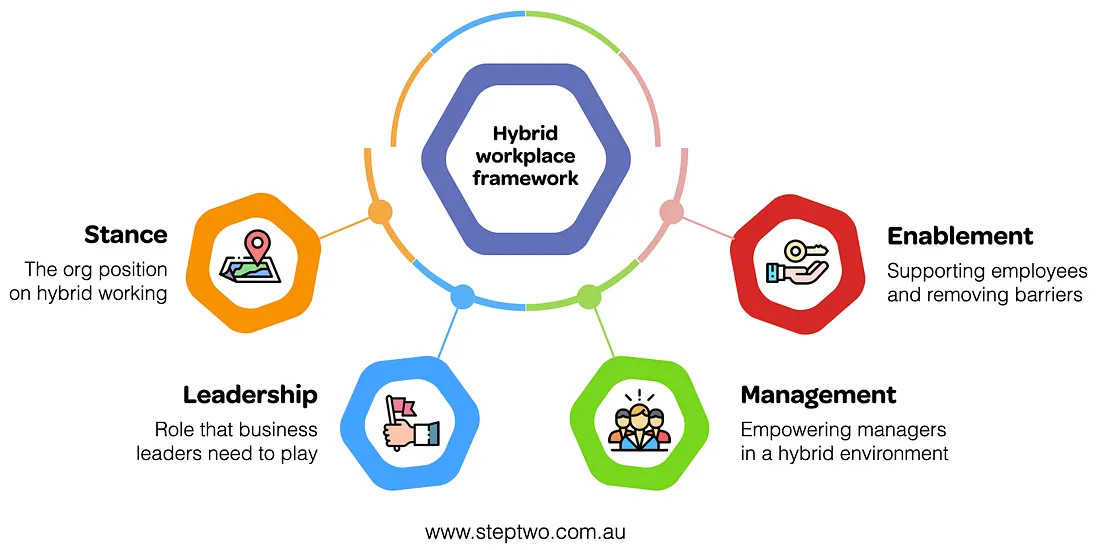
Introducing the hybrid workplace framework
What is clear from our engagements with clients is that nobody is standing still. Almost all organisations kicked off multiple projects, covering a wide spectrum of considerations, from IT infrastructure upgrades, to the rollout of new collaboration tools, the refitting of office meeting rooms and the review of employee value propositions. These transformations are still very much underway.
What has proven challenging for all firms, however, is having a clear map of what’s being done, a concrete idea of what’s missing, and a clear message that can be communicated to all employees.
This is where Step Two’s Hybrid workplace framework, shown above, adds value, for senior leader teams down to individual line managers. It doesn’t specify fixed answers for all firms, but rather provides a mechanism to take a strategic — rather than reactive — approach to hybrid working.
Each of the elements is described in the following sections.

Stance
Every strategy must be led by a clear future vision, showing the desired end state, and this is no different for the hybrid workplace.
More than just a future vision, the firm’s stance must give concrete guidance on the overall approach that will be taken.
The stance needs to address key considerations, such as:
- What is our overall approach to hybrid working?
- How will it apply across geographies and business areas?
- What flexibility is there for individual decisions by people leaders?
- Is it time-limited, or expected to change in the coming year?
- How much assistance will be given to helping establish home-based working environments?
- What will be put in place to ensure a successful shift to hybrid working?
This must consist of more than just aspirational vision-mission statements. What everyone is crying out for at present is a clear line in the sand, communicated clearly and succinctly by senior leaders.
This is an example of what such messaging could look like:
“We will be providing the vast majority of our workforce the opportunity to work flexibly between the office and home, with the exception of those business areas that must operate on-site.
“We will all be learning new work practices that are more productive in the hybrid workplace, and digital tools will play a much stronger role than before
“People leaders will be empowered to make decisions about the working practices of their team or business unit, in consultation with their teams.
“All employees must have a safe and productive work environment. If for any reason that’s not at home, then come into one of our offices.
“Over time, we will be providing you with devices that will enable you to work more flexibly. We will also be providing a stipend to allow you to improve your home-working environment.”
This is not about driving hybrid working decisions entirely from the top-down — quite the opposite! People leaders, however, need to know the direction they should align with, and feel like they can make informed decisions. Employees need to know the ‘rules of the road’ from the outset.
Leadership
The shift to a hybrid workplace is a transformative one for almost every aspect of businesses, from daily working practices to office space fitout and mechanisms for client interaction.
Hybrid workspace initiatives must therefore be spearheaded by the whole senior leadership team, with each leader taking up the mantle of addressing aspects that fall into their area of responsibility. Leaders will need to communicate early — and often — about hybrid working directions, as they did during the pandemic itself.
Senior leaders will also need to be directly involved in key decisions, with multi-decade impacts on real estate, technology and workforce changes.
What continues to be challenging for some leaders is to shift their personal working practices to more visibly match the changes happening in the wider workforce.
Without making assumptions about today’s senior leaders, it’s reasonable to assume that they will face many of the same adjustments that confront other employees.
The good news is that during the pandemic, employee engagement actually rose in many firms, even as their workforces weathered sudden and sustained disruption. A significant driver for these improvements involved the shift of senior leader engagement more comprehensively online.
Rather than excessively formal ‘town hall presentations’ conducted face-to-face, leaders switched to live videos with two-way engagement. Often presenting from home, these online sessions made it easy for leaders to communicate more informally, which proved more enjoyable for all involved. Many senior leadership teams also ramped up their online communication and participation in enterprise social tools.
In many ways, leadership teams need only continue practices established during the pandemic in order to give good support for the emerging hybrid workplace.
Management
Leading and managing employees in a hybrid workplace is without question more challenging than in a traditional office-only environment. While the management textbooks have extolled for decades the principle of manage output not activity, this is not the culture or default practice in many firms.
To make this a sustainable reality into the era of the hybrid workplace, widespread changes will need to be made to employment practices. This includes revising HR policies and processes, reshaping onboarding processes, updating how employee engagement is tracked, tuning employment conditions and expanding employee benefits.
People managers will also require additional training and support to be fully effective in the hybrid workplace. Areas of particular challenge include:
- onboarding staff
- communication methods and styles
- fostering a shared culture
- employee recognition
- management oversight
- performance appraisals and promotions
- feedback and coaching
- day-to-day working practices, particularly using digital tools
Past efforts to support remote working often foundered on the reluctance of local line managers to provide approval for their staff to work from home, and this highlights the importance of bringing people managers along the journey.
Enablement
One of the most powerful outcomes from the pandemic was to show that remote work — using digital tools — really can work for the vast majority of employees and job roles.
As the ‘can do’ attitude shifts into the ‘new normal’, however, much more will need to be done to enable employees and businesses to be fully effective in the more complex hybrid working landscape.
These enablement activities must address three key aspects:
- digital literacy
- technology enhancement
- digital employee experience
Digital literacy, once thought of as the process of training one’s grandparent to use the internet, is now a key skillset for most workers. A substantial uplift will be required, to equip individuals and teams to work in new ways that straddle the digital and physical worlds.
Take the humble meeting. In the past, these were held in their millions in meeting rooms of office complexes around the world. All were present in person, and modes of interaction were well established (if not widely liked). these meetings ran reasonably efficiency for all involved, although not perhaps for the sole person on video link, forgotten by all.
During the pandemic when everyone was working from home, meetings suddenly became all-virtual. To Zoom became a verb and we all became used to days filled with back-to-back video meetings. To the surprise of many, these worked just fine, even if research has shown the reasons for the very real phenomenon of ‘Zoom fatigue’.
The hybrid workplace is a messy combination of in-person and remote. As anyone who has tried running meetings in this environment will report, having half the people in the office and half in their homes simply doesn’t work. While we continue to work out new behaviours and cultural norms for these hybrid meetings, many teams now mandate that if more than two people are remote then everyone is remote, even those based in offices.
This is perhaps the simplest example of a new set of skills and behaviours that will be needed for digital interactions in the hybrid workplace. Alongside these will need to be a wholesale shift into more mature and widespread use of collaborative tools and online platforms.
All this should make digital literacy a priority for IT teams, HR departments and business leaders. We are only just learning now how extensive these expanded skillsets will need to be.
When it comes to technology enhancement, many organisations made rapid and significant investments when Covid-19 first hit. Most larger firms now have a well-established set of digital workplace tools.
More investment, however, is needed to make the most of tools that were rolled out.
Adoption of collaboration tools for example, is still shallow and inconsistent across many firms. Maturity levels are still low, and in many cases, organisations have been reluctant to fully enable the features that are provided by new platforms.
A sustained digital workplace program will be required, to identify gaps and deficiencies, and to further roll out new solutions. These technology-oriented programs of work must be closely aligned with digital literacy initiatives, to ensure the best outcomes are obtained.
The third area of enablement required relates to the digital employee experience provided to key staff roles. This goes beyond the basics of what features and functionality are provided, to consider whether the experience is simple, productive, usable and effective.
The pandemic shone a light on the importance of frontline roles in delivering key services, and it showed how all too often customer-facing employees had to struggle through the constraints of clunky systems and missing technology capabilities.
In terms of hybrid working, leaders should take stock of the digital experiences of frontline staff in particular, and then take steps to make substantial and strategic changes. The role of the CHRO will then be critical for delivering improved digital experiences for the wider workforce.
Complexities, and opportunities
The pandemic drove a decade of change in a matter of days, and the shift to greater flexibility in working practices is rightly celebrated.
If there’s no going back to the entirely office-bound working environment of the past, the future of hybrid working is still being written, years on from the pandemic. Senior leaders must lead these workplace changes from the front, taking steps to maximise outcomes for all, and mitigating the challenges as they arise.
By making use of the hybrid workplace framework, senior leaders and taskforce members can put shape around plans for the coming years.