
Tackling the global-local challenge?
Categorised under: Intranets
In recent projects, we’ve been doing a lot of work relating to what Jane McConnell calls the global-local challenge of intranets. In any large organisations, there will be many different business units, with different needs. Individual staff across the organisation will also need specific tools and information.
The challenge is to meet global needs (corporate communications, top-level strategy, culture), while also meeting varying local needs. There is no one-size fits all solution to this. Jane has published some great models, and we’re now doing some more detailed work around strategic and IA approaches to the issue.
Take one of our current clients as a case in point.
Global-local in a government agency
This is a mid-sized government agency, formed some time back by a merger of previous agencies. The result was a core agency, with a number of semi-independent elements under the overall structure. Each of the previous organisations had an intranet, although not all were in a good shape.
Work has been done on the top-level corporate intranet, but our project is with one of the semi-independent business units. Their intranet had decayed over the last years, and the goal was now to revitalise it. Our research showed that there was a very real (and very important) need, and we’ve made a number of recommendations.
Now comes the part when we address the information architecture issues. In discussions with our client, we sketched out two high-level approaches:
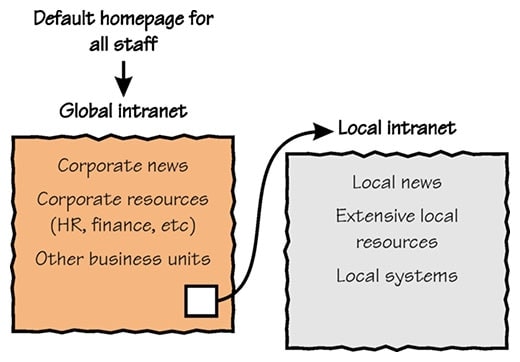
Option 1: global first, then local

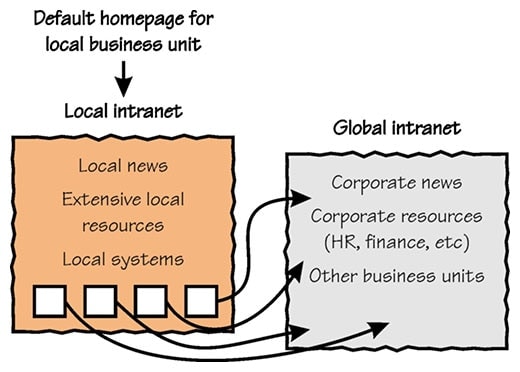
Option 2: local first, then global
Option 1
In this approach, the corporate intranet remains as the default homepage for the whole organisation.A link is made to the local intranet, where business unit specific information can be obtained.
(This is more-or-less the current situation.)
Advantages:
- strengthens the global homepage, and global news
- consolidates into a single entry point for the whole organisation
- provides quick access to corporate resources (HR, finance, etc)
Disadvantages:
- hides access to local resources
- provides a poor solution for meeting local needs
- doesn’t offer a good home for local news
- impacts on usage of the local intranet
Option 2
In this approach, the business unit intranet becomes the default homepage for staff within that area. Links are then made to the organisation-wide policies and procedures (HR) on the corporate intranet.
Advantages:
- provides a homepage tailored to the needs of the business area
- provides a clear home for local news
- addresses business unit needs not covered by corporate intranet
- builds local cultural identity and branding
Disadvantages:
- reduces traffic to the corporate homepage
- weakens the effectiveness of the corporate homepage as a news channel
- makes it harder to deliver corporate news and information?
- requires extensive linking to the corporate intranet (which could be confusing for users)
- impacts on the desired “one organisation” culture?
The answer?
We’ve looked at this issue in previous projects, including at a major Australian bank and a local arm of a corporate multinational. We’re starting to build out a “toolkit” of possible approaches, and this is steadily evolving and refining.
But before I share our ideas, what are your thoughts on how to tackle the situation outlined above?
James Robertson is the Managing Director of
7 Comments:
Hi James,
Look forward to the outcome, but I would probably add one more element to the mix. I battle with company, business and country level communications, and at a lower level, classes of business and locations.
Andrew
Hi James,
What about personalised pages? Where staff can create their own page choosing content from both Local & Global resources as well as some mandatory content. I would be interested in hearing your advantages and disadvantages of such a model. From my experience the biggest downfall in such a solution is giving people the knowledge to build the site then the barrier of them wanting to do it.
craigcoomans
@Andrew, yes, this is definitely a simple case. Thought we would start with a reasonably easy one before moving onto the harder problems…
We are tackling this problem right now. The most probable solution right now seems to be a partly personalized start page, with content both from the users local office and the head quarters.
The user also have the option to add completely personal content, such as e-mail and calendar.
This increases the chance of the user to actually read the global information.
Also, I have understood that most users do not use personalization at all, so the default settings has to be “good enough”.
Sounds uncannily familiar…..
I’ve been doing quite a bit of thinking around a very similar scenario recently.
First principles – the needs of staff and management. I’m making a few guesses here based on past experience, if my assumptions on needs are wrong then so is the following conclusion.
Senior Management: To present a globally consistent view of the organisation with standard design, messaging and tools.
Business Line/Team Management: To ensure staff are as productive as possible. To quickly communicate operational changes relevant to the area and improve staff engagement.
Staff: To complete the tasks relevant to their roles quickly and smoothly and to remain connected to their teams, site and stakeholders. To find the right people fast.
There is often tension between these goals….
I would consider a standard homepage with both corporate-level messages and user-level customisation.
This way people have a starting view of corporate news and tools with areas that are automatically customised by role/team/business line (via the central HR system) to provide the local/business line news and resources needed.
Would also consider as a back-up and as support for specific needs having elements of the page customisable by individuals – or cascaded down by business lines/teams.
Of course it requires the right enabling infrastructure, which may not be available in the case you are describing.
Cheers,
Craig
Great post.
This is an issue we will need to consider for our intranet in the future. I’ll take guidance from our users by presenting them with various options and see what they like most. But if I had to make a decision now I would probably lean towards option 2. Local intranets are more likely to contain higher value information for the local user than the corporate home page. I’d be really interested to see how many staff actually choose to access the corporate home page if it was presented as an optional link rather than forcing users to open it every time they access the intranet.
James have you got any data on this?
Patrick
I’m afraid I don’t have any data on the usage of different models. But I definitely would aim for a global decision on the overall model, rather than presenting options to individual business units
2 Trackbacks
[...] I was also in charge the analysis all along the project, and my objective was to develop a new design that would meet better user needs and improve the usability. We established a modular model that organizes all the content within a common structure. The Corporate content is organized in 1 giant site called the group site and is placed at the center of all the online information. It has a specific IA that assists users to find its immediate content (group wide content), and it has a design that links better to all the other resources available online. Then around the group site, there are as many micro-sites as there are business units and communities of practice. The fashion of the Intranet is actually similar to the universe with planets around the Sun.Step Two published a post ad-hock to describe a bit more our analysis. I invite you to visit their findings at this url. [...]
[...] I was also in charge the analysis all along the project, and my objective was to develop a new design that would meet better user needs and improve the usability. We established a modular model that organizes all the content within a common structure. The Corporate content is organized in 1 giant site called the group site and is placed at the center of all the online information. It has a specific IA that assists users to find its immediate content (group wide content), and it has a design that links better to all the other resources available online. Then around the group site, there are as many micro-sites as there are business units and communities of practice. The fashion of the Intranet is actually similar to the universe with planets around the Sun.Step Two published a post ad-hock to describe a bit more our analysis. I invite you to visit their findings at this url. [...]