

Three tiers of collaboration

Written by James Robertson, published November 18, 2008

Categorised under: Collaboration, Knowledge management

There are many elements of collaboration, and we often encounter the “blind men and the elephant problem”. We’re all talking about collaboration, but we’re actually discussing different parts of the animal.

Some people are referring to technology when they talk about collaboration, others are looking at the “collaborative culture” within organisations, while still others consider collaboration from an individual’s perspective. All are valid topics, but the breadth of collaboration can lead to crossed lines when we try to bring them all together.

Within an organisation, it’s easy to get caught up in just a few aspects of collaboration, leaving big holes that impact on short and long-term success. How do we ensure we’re looking at all the necessary elements of collaboration?

While sitting in an airport on the way back to Australia, a overall model for collaboration coalesced in my mind, bringing together all the different aspects of collaboration. This is still in its infancy, but I thought it would be useful to share it, and to get some feedback.

A model: three tiers of collaboration
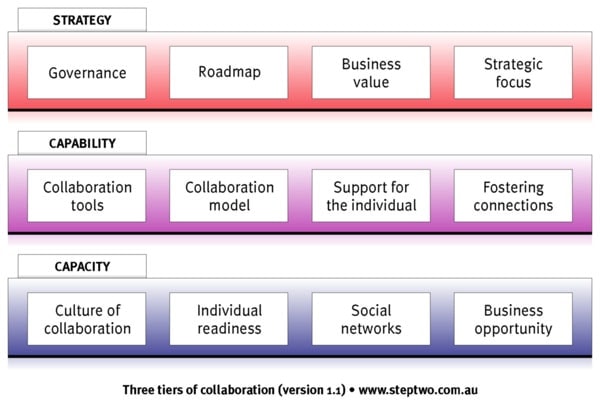
Each tier builds on the one below, starting with capacity (pre-requisites for collaboration), through capability (strength of collaborative activities and approaches) to strategy (overall focus on collaboration).

A brief outline of each item, starting from the bottom up:

Capacity

  • Culture of collaboration – integration of collaborative practices into “the way we work” throughout the organisation.
  • Individual readiness – the skills, background, practices and personality of individuals for collaboration.
  • Social networks – the breadth and strength of social and interpersonal relationships within the organisation.
  • Business opportunity – the time and opportunity for collaboration within daily work practices and overall business model.

Capability

  • Collaboration tools – designing and deploying effective collaboration tools.
  • Collaboration model – overall model for collaboration, in the context of information management strategy.
  • Support for the individual – providing individuals with personal tools and support for collaboration.
  • Fostering connections – skills and support for fostering interaction and relationships between people.

Strategy

  • Governance – ownership, resourcing and decision making processes for collaboration.
  • Roadmap – overall strategy and roadmap for the adoption and growth of collaboration within the organisation.
  • Business value – demonstrated business or organisational value of collaboration, and alignment with core business goals.
  • Strategic focus – organisation recognises collaboration as a ‘top line’ element of overall success and strategy.

Using the model

This is a descriptive model, that oulines all the elements of collaboration, and it can be used in a variety of ways:

  • as the basis for a self-assessment of where collaboration activities are currently focused in the organisation
  • to identify areas of strength and weakness in collaboration strategies
  • as the basis for research and learning about collaborative approaches
  • as a way of structuring a collection of collaboration techniques and approaches
  • as a shared model to build understanding between practitioners of collaboration

As previously indicated, this is an early version of the model, very much a work-in-progress. Your questions, suggestions or improvements?


Tags: , ,

10 Comments:

  1. I like these three distinctions a lot. I am familiar with Hubert Saint-Onge’s distinction between the organization’s “absortion capacity” and strategic capability, but have often had trouble explaining the distinction to others. If I were to simplify the model, I’d put it as

    Capacity: readiness (what the organization could hold)
    Capability: what the organization is able to do given the skills, knowledge, and environment it provides
    Strategy: the structures that focus collaboration toward specific purposeful goals

    thanks for the model!

    /patti

  2. Hi Patti, that’s a nice description for each of the levels, thanks!

  3. James,

    Nothing like tackling the big questions, great stuff.

    To me the way you have made obvious that collaboration requires a healthy soil (capactiy) is great. Often I’ve seen, to carry on with the garden metaphore, growth (capability) being attempted on concrete. Similarly expectations of wonderous fruit (strategy) without putting the effort into either the soil or nurturing the plants is not uncommon.

    I’m looking forward to how others see this model and how it develops.

    DorjeM

  4. Thei Geurts commented on November 19th, 2008

    I tend to agree with Patti and James. The model is simple but effective.

    If you translate it to abilities, it would/could be:

    Strategy: ability to visualize (meaning: a vision that you can bring to life)
    Capacity: ability to perform (we can do it)
    Capability: ability to execute (we do it)

  5. James, I like the stratification of the concepts into three different levels. I confess to being uneasy with the “collaboration model” element, though. Does this make it a model within a model? “Model” in this context is rather vague; I can’t help thinking that there is a more precise way of expressing what you mean. Do you mean “collaboration processes” (or, for those of us used to working with the military, collaboration concepts of operation, or CONOPs)? My experience is that most groups need the aid of an explicit, agreed-upon set of rules or procedures for what collaboration mechanisms they will use for different types of situations. Analogous to the “support for individuals” element, the “collaboration processes” element would provide (non-technology) support for groups.

  6. Hi Jill, the naming of all the elements needs reviewing! Thanks for the input.

    But in terms of what I mean by a “model for collaboration”, have a look through this slidecast:

    http://www.slideshare.net/jamesr/ten-tips-for-collaboration-audio/

  7. gstene commented on January 4th, 2009

    Hi, thanx for a great model.Being a consultant within the internet business, naturally my focus is on digital supported tools to achieve collaboration. However no technology will solve the problem itself. It is the organizationa ability to implement the collaborative effort that will make digital cllaboration work with a realistic set up of critherias.

  8. Yes, I think this is the big challenge. We now have the tools, but how do we foster successful people-to-people collaboration within organisations?

  9. Thanks for this model James. I work for a small not for profit and am trying to think through the implications of online collaboration for us as an organisation. Previously our collaboration has been done in a very informal way, such is the nature of our organisation. I would hope we could continue with this culture but change our processes to include a digital/online component.

    Thanks again.

  10. James, now that you’ve had some time to work with this model, do you have a case study that you can share with us? In other words, it would be great if you have something that says, here’s how we applied the model and here’s what it was helpful for and what it wasn’t so helpful for. Also, have you documented these ideas in an archival form such as a conference paper or journal article, or is this web page still the definitive reference for pointing others to these ideas? Thanks in advance for your response.

2 Trackbacks

  1. By Harold Jarche » Communities of Practice on March 13, 2009 at 11:32 pm

    [...] Australian resource I found via Jack Vinson is three tiers of collaboration from Column Two, a good model to examine organizational readiness regarding – Strategy, Capability [...]

  2. By Harold Jarche » Starting an Online Community on March 25, 2009 at 1:19 am

    [...] a collaborative working/learning space. I’ve previously referred to Column Two’s three tiers of collaboration – Capacity, Capability & Strategy and it’s a good model to start with. Part of capacity [...]

Post a Comment

Your email is never published nor shared. Required fields are marked *

*
*

Comments for this post will be closed on 4 August 2009.